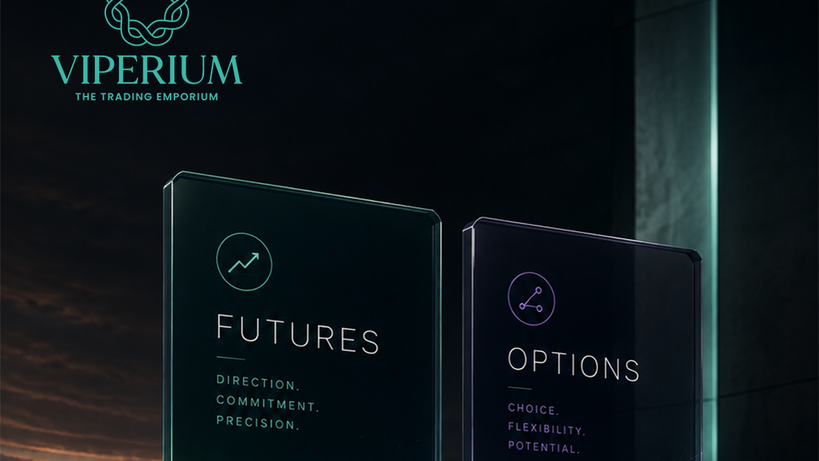
Picture two traders who will never meet, staring at two different screens, convinced of the exact same thing: a broad stock market index is about to climb over the next several weeks. Neither owns any of the underlying shares. Neither wants to just sit and hope. Both are ready to turn a hunch into a position.
One of them buys an options contract. It costs a few hundred dollars and hands over the right, not the obligation, to buy the index at today's price sometime before the contract expires. If the market cooperates, they profit. If it doesn't, the most they can lose is what they paid for that right, and not a cent more.
The other trader buys a futures contract on that same index. No premium changes hands the way it did for the option buyer. Instead, they post a deposit, a fraction of the contract's full value, and in exchange they take on a real commitment. If the index rises, they profit, and they profit on far more money than they put down. If it falls, they owe the difference, and there is no built-in ceiling on how large that difference can get.
Same hunch. Same direction. Two very different relationships with risk. Everything else in this piece grows out of that one gap.
Maybe vs Must
An option is basically a ticket. You paid for the right to do something later, and you get to decide, right up until the deadline, whether using that ticket still makes sense. If it doesn't, you simply let it expire and walk away, out only the price of admission.
A futures contract is closer to a handshake agreement. There is no walking away built into it. Whoever holds one side of that contract has agreed to buy the asset at a set price on a set date, and whoever holds the other side has agreed to sell it, full stop. Most traders never actually take or make delivery of anything; they close their position before the contract runs out. But the underlying commitment is real the entire time they hold it, not optional.
That difference, choice versus commitment, is the single most important thing to understand before touching either market. It shapes everything that follows: how much these contracts cost, how the risk behaves, and who tends to gravitate toward one over the other.
Paying Once, or Paying Every Single Day
Buying an option is a one-time transaction from the buyer's side. You pay the premium up front, and that's the whole financial relationship. Nothing else gets deducted from your account overnight, no matter what the underlying asset does the next day, the day after, or the day after that. Your cost was fixed the moment you bought in.
Futures work on a completely different rhythm. Instead of a premium, you post margin, a good-faith deposit that lets you control a much larger position than the cash you put down would normally allow. Every single trading day, that position gets marked to market: gains and losses are calculated and moved in or out of your account as if you'd closed the position right then. A good day adds cash. A bad day pulls it out, and if your account balance drops below a required level, you get a margin call demanding you add more money just to keep the position alive.
So an option buyer pays once and waits. A futures trader settles up daily, whether they like the number or not.
Where the Floor Is, and Where It Isn't
This is where the story of those two traders is worth finishing.
Say the index really did rally over the following weeks, just as both traders expected. For the option buyer, that rally was pure upside. As the index climbed, the value of their right to buy at the old, now-lower price climbed with it. They didn't even need to exercise the option; they simply sold that right back into the market before it expired, for several times what they'd originally paid. A modest, fixed amount of risk had turned into a genuinely satisfying payoff, and at no point along the way could their loss have been any worse than that original premium. That was the ceiling on the bad outcome from day one.
Now flip the story around. The person on the other side of that options trade, the one who sold the right rather than bought it, doesn't get that same protection. If the market moves hard against them, their potential loss has no built-in ceiling at all. And the futures trader from the opening scene is in a similar spot, just on both sides at once: a rally would have meant a real profit, credited daily, but a slide in the other direction would have meant real, mounting losses, also debited daily, with margin calls arriving to demand more cash exactly when it's least welcome.
That's the asymmetry worth sitting with. Buying an option gives you a known, capped worst case. Selling one, or trading futures in either direction, does not. The potential loss can keep growing for as long as the position stays open.
Why Any of This Exists in the First Place
None of this was built for its own sake. These kinds of arrangements are far older than modern exchanges, computers, or clearinghouses; long before any of that existed, people were still striking informal agreements to fix a price today for something that would change hands later, because guessing and hoping is a rough way to run a business.
A company that depends on the future price of some raw material, a currency, or anything else it regularly buys or sells in bulk can use a contract like this to lock that price in ahead of time and remove one big unknown from its planning. Everyone else, the traders with no intention of ever taking delivery of anything, uses those same kinds of contracts to bet on where a price is headed, often committing far less capital than buying the underlying asset outright would take. The business wants certainty. The speculator wants opportunity. Both need the other to be in the market for any of it to work, since every contract needs someone willing to take the opposite side.
The mix of people actually placing these trades is wider than most beginners assume. Businesses hedge costs and revenues they can't otherwise control. Large funds and institutions use both markets to manage or deliberately increase their exposure. Professional trading firms supply much of the constant buying and selling that keeps prices moving in an orderly way. And a large, growing share of the activity in both markets now comes from individual traders working off a laptop, no different in spirit from the two people in the opening scene.
They Don't Even Share a Clock
Here's something that catches a lot of newer traders off guard: these two markets don't even run on the same schedule. Stock options generally trade during the same defined trading day as the shares underneath them, opening and closing at familiar times each business day, then going quiet overnight and over the weekend. Futures keep a far longer, far less forgiving schedule. Many futures markets are open for nearly the entire day and deep into the night, picking back up again well before the stock market has stirred, with only a short pause each day and a longer break over the weekend.
Practically speaking, that means news breaking overnight can already be pushing futures prices around before the options market has even opened for the day. Anyone trading both needs to understand that one of them never really stops watching.
Which One Is Actually You
There's no universally correct answer here, only a better fit for a given trader's temperament, capital, and appetite for daily monitoring.
Options tend to suit people who want their worst case defined in advance and who would rather risk a smaller, known amount than a larger, open-ended one. They're forgiving of a trader who can't watch the market constantly, since the maximum damage is locked in the moment the trade is placed. The tradeoff is that an option can expire worthless if the move you predicted doesn't happen in time, and time itself works against the buyer with every day that passes.
Futures tend to suit people with higher conviction, more capital to post as margin, and the stomach (and the schedule) to handle a position that settles up every single day, in either direction. There's no premium quietly eroding in the background, but there's also no ceiling protecting you from a bad stretch. It's a tool built for someone who wants direct, undiluted exposure and is comfortable managing the consequences of that in real time.
Plenty of experienced traders eventually use both, reaching for whichever tool matches the size of their conviction and the amount of uncertainty they're willing to sit with on any given trade.
Back at Those Two Screens
Return, one more time, to those two traders. One paid a small, known amount for a chance and could never lose more than that. The other made a real commitment, with real consequences running in both directions, settled fresh every day the position stayed open. Neither choice was wrong. They were simply two different ways of turning the same hunch about the future into a position today: one a ticket you're free to let expire, the other a handshake you don't get to take back.